 Database and Forum


Sheikh Çelebi Khalifa
Sheikh Çelebi Khalifa (1)
“Al-‘Arif Billah” Sheikh Shams Al-Din (also known as Muhi Al-Din, Muhammad Çelebi Sultan, and—more popularly—Çelebi Khalifa Bin Muhammad Al-Jamali Al-Bakri Al-Khaluti Al-Rumi) was a jurist, muhaddith (transmitter of hadiths), and exegetist of the Qur’an who was a descendant of Sheikh Jamaluddin Al-Aqsara’i (Jamaluddin Muhammad Bin Muhammad Bin Muhammad Bin Fakhr Al-Din Al-Razi), a descendant of Imam Fakhr Al-Din Al-Razi, who was, in turn, a descendant of Abu Bakr Al-Siddiq whose ancestry could be traced to the tribe of Taym, a sub-clan of the tribe of Quraysh.
As a young man, Sheikh Çelebi Khalifa was focused purely on gaining knowledge. As he delved into Al-Sharh Al-Mukhtasar lil-Talkhis, he became deeply attracted to the teachings of Sufism. He first secluded himself in Karaman with Sheikh Abdullah, one of the successors of Sheikh ‘Ala’ ad-Din Al-Khaluti. During that period, Mawla ‘Ala’ ad-Din was in Karaman, so he went to him and saw him riding on a black horse whilst clad in a black jubbah and turban. When Sheikh Çelebi Khalifa expressed admiration towards him, Sheikh ‘Ala’ ad-Din told him: “If you desire this jubbah, I will give it to you.” Upon hearing this, Sheikh Çelebi Khalifa responded that one who wears the khirqa must be deserving of it, and that he did not deserve to wear it. The Sheikh told him: “Then you are in need of my disciples.” Shortly thereafter, the Sheikh died whilst still in Karaman, with Sheikh Abdullah dying soon after him.
After this, Sheikh Çelebi Khalifa went to the town of Tokat, where he stayed in seclusion with a sheikh known as Ibn Taher, who used to order his disciples to engage in strenuous exercise. Some of them could not handle this, so Sheikh Ibn Taher dismissed them all until Sheikh Çelebi Khalifa alone remained there with him. He continued the physical activities required of him until the sheikh was informed one day how preoccupied he was with the exercises. His response to this was: “Let him keep going until he dies.” Sheikh Ibn Taher was from the people of Al-Tarakama. Although illiterate, he was also a man possessing great inner strength. It was documented at the time that Çelebi Khalifa had a divinely-revealed vision, which he told the sheikh about. Sheikh Ibn Taher dealt with him kindly after that and then eventually passed away.
Following this, Sheikh Çelebi Khalifa went to the town of Erzincan, where he befriended Mawla Biri. He then set out towards Şirvan in order to serve Sayyid Yahya. Two days after he left Erzincan, however, he heard that Sayyid Yahya had died, so he returned to Erzincan and continued to serve Mawla Biri, who sent him to Anatolia to teach the poor.
It was reported that Vizier Karamani Mehmet Pasha, who served as Grand Vizier under Sultan Mehmed Khan (Sultan Mehmed II, also known as Muhammad Al-Fatih), was more inclined towards Sultan Cem, and showed contempt for Sultan Bayezid Khan (who was Sultan Bayezid II, the son of Sultan Muhammad Al-Fatih, who conquered Constantinople, and the father of Sultan Selim I, who conquered Egypt) in front of his father. Sultan Bayezid Khan thus appealed to Sheikh Çelebi Khalifa, who tried to excuse himself from the matter. Sultan Bayezid Khan continued appealing, so he finally went to him and saw the saints of Karaman next to Sultan Cem. When Sheikh approached them, they threw flames at him, missing him and hitting his daughter instead. A few days after this incident, his daughter became sick and died.
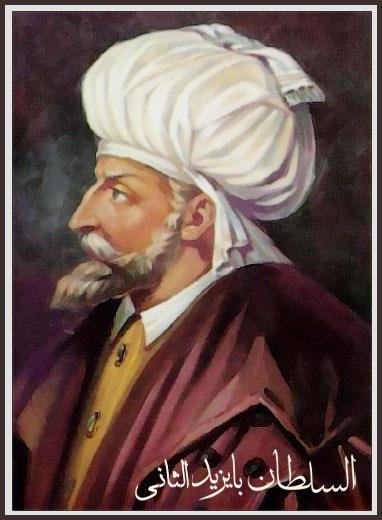 Sultan Bayezid II
Sultan Bayezid Khan once again appealed to Sheikh Çelebi Khalifa and reached an understanding with him. So he went again, whereupon the saints of Karaman appeared and asked him what he wanted. In response, he said: “This man (meaning Vizier Karamani Mehmet Pasha) has suspended all endowments for the Muslims and has instead routed them to the state treasury—so everyone has halted their support of him, except for Sheikh Ibn Al-Wafa’.”
Taşköprüzade, who was present at the time, witnessed Sheikh Çelebi Khalifa drawing a circle around the vizier (with the intention of placing a “curse” on him due to his anger at losing the endowments). Taşköprüzade said (regarding himself) that he entered the circle with great difficulty, and predicted that the results of [the curse] would become apparent in thirty-three days.
So great was Sheikh Çelebi Khalifa’s anger that he was quoted as saying that the curse affected everyone in the area named Muhammad (Mehmet), which was also the name of the vizier.
One narrator said: “My name was also Muhammad, and at the time, I was a young boy. I climbed a tree, and the branch broke, so I fell and cut my head. At the time, we were in the town of Amasya, and they counted forty men there named Muhammad who were all struck by the calamity.”
It was reported that when thirty-three days had passed, news of Sultan Mehmed Khan’s death came, so Sultan Bayezid Khan headed to Constantinople. Five days after his departure, he heard on the way that Vizier Mehmet Pasha had been killed.
After Sultan Bayezid Khan ascended the throne, he sent Sheikh to the Hajj pilgrimage along with forty of his friends to pray there for the plague to be eliminated from Anatolia. He gave the sheikh a bag of dirhams, also giving each one of his friends three thousand dirhams for themselves. On the way, however, the sheikh passed away.
It was reported that after the sheikh set out for Hajj, the plague lessened in Constantinople for several years. It actually stopped altogether during that period due to Almighty Allah’s will—may Allah bless the dear sheikh’s soul.
In his book of history, scholar and historian, Sheikh Abdel-Rahman Al-Jabarti (d. 1237 AH), described Sheikh Çelebi Khalifa’s sanad within the Sufi Khalwati (Halveti) Order as follows:
According to the best muhaddiths in the chain, Ali Bin Abi Talib (may Allah be pleased with him) transmitted to Al-Hasan Al-Basri. Al-Hasan Al-Basri then transmitted to Habib Al-Ajami, who transmitted to Dawud Al-Ta’i, who transmitted to Ma’ruf Al-Karkhi, who transmitted to Siri Al-Saqti, who transmitted to Aba Al-Qasim, the “Master of the Two Sects” (Al-Junaid Al-Baghdadi)—from whom all known orders in Islam originated.
Al-Junaid then transmitted to Muhmmad Al-Dainwari, who transmitted to Muhammad Al-Dainwari, who transmitted to Judge Wajih Al-Din, who transmitted to Umar Al-Bakri, who transmitted to Aba Al-Najib Al-Suhrawardi, who transmitted to Qutb Al-Din Al-Abhari, who transmitted to Muhammad Al-Najashi, who transmitted to Shihab Al-Din Al-Shirazi, who transmitted to Jalaluddin Al-Tabrizi, who transmitted to Ibrahim Al-Kilani, who transmitted to my brother (in faith) Muhammad Al-Khalwati (to whom the members of the order trace their ancestry), who transmitted to Pir Umar Al-Khalwati, who transmitted to my brother Biram Al-Khalwati, who transmitted to Ezz Al-Din Al-Khalwati, who transmitted to Sadr Al-Din Al-Khayali, who transmitted to Yahya Al-Shirwani (the author of Wird Al-Sattar), who transmitted to Pir Muhammad Al-Erzincani, who transmitted to Çelebi Sultan, known as Çelebi Khalifa.
– End of Summarized Citation
Among Sheikh Çelebi Khalifa’s authored works were: Mi’raj Al-Arwah fi Qawa’id Al-Ta’bir, Tafsir Ayat Al-Kursi, Jami’at Al-Asrar wal-Ghara’ib, Sharh Al-Arba’in Al-Qudsiyyah fi Al-Hadith, and Tafsir Al-Fatihah.
Sheikh Çelebi Khalifa died in 886 AH (1481 AD).
Prepared by: Ahmed Abdul-Nabi Farghal Al-De’abassi Al-Bakri
General Secretariat of the Sheikhdom of Sijjada Bakria –
Chairman of the Lineage Investigation Committee
Date of Publication
1 Ramadan 1438 AH / May 26, 2017 AD
ـــــــــــــــــــــــــــــــــــــ
Bibliography and References:
1. Shatharat al-Thahab Fi Akhbar Min Dahab, Abdul-Hayy Bin Ahmed Bin Muhammad Ibn Al-‘Imad Al-Akri Al-Hanbali, Abu Al-Falah (d. 1089 AH), Editor: Mahmud Al-Arnaout, Dar Ibn Katheer, Damascus – Beirut, First Edition 1406 AH – 1986 AD.
2. Al-Kawakib Al-Sa’ira bi-Ayan Al-Mi’ah Al-‘Ashirah, Najm Al-Din Muhammad Bin Muhammad Al-Ghazzi (d. 1061 AH), Editor: Khalil Al-Mansur, Dar al-Kutub al-‘Ilmiyah – Beirut, First Edition 1418 AH – 1997 AD.
3. Sullam Al-Wusul ila Tabaqat Al-Fuhul, Mustafa Bin Abdullah Al-Qonstantini Al-‘Uthmani, known as Katib Çelebi (The “Gentleman Scribe”) and Hajji Khalifah (Haci Halife) (d. 1067 AH), Editor: Mahmud Abdul-Qader Al-Arnaout, IRCICA Library – Istanbul, 2010 AD.
4. Al-Shaqa’iq Al-Nu’maniyya fi ‘Ulema’ Al-Dawla Al-‘Uthmaniyya, Ahmed Bin Mustafa Bin Khalil, Abu Al-Khair, Isam Al-Din Taşköprüzade (d. 968 AH), Dar Al-Kitab Al-‘Arabi – Beirut.
5. Tarikh Aja’ib Al-Athar fi Al-Tarajim wal Akhbar, Abdel-Rahman Bin Hasan Al-Jabarti the Historian (d. 1237 AH), Dar Al-Jeel – Beirut.
6. Mu’jam Al-Mufassirin: Min Sadr Al-Islam Hatta Al-‘Asr Al-Hadir, ‘Adil Nuwayhid, Introduction by: Grand Mufti of Lebanon, Sheikh Hassan Khaled, Muassasah al-Nuwayhid al-Thaqafiyyah lil-Ta’lif wal-Tarjamah wal-Nashr – Beirut, Third Edition 1409 AH – 1988 AD.
7. Mu’jam Al-Mu’allifin, Umar Bin Rida Bin Muhammad Raghib Bin Abdul-Ghani Kahhalah Al-Dimashqi (d. 1408 AH), Maktabat al-Muthanna – Beirut, Dar Ihya al-Turath al-Arabi – Beirut.
(1) Sullam Al-Wusul ila Tabaqat Al-Fuhul 3/ 299, Al-Kawakib Al-Sa’ira bi-Ayan Al-Mi’ah Al-‘Ashirah 2/ 236, Shatharat al-Thahab Fi Akhbar Min Dahab 10/ 313, Al-Shaqa’iq Al-Nu’maniyya fi ‘Ulema’ Al-Dawla Al-‘Uthmaniyya pp. 162-164, Tarikh Aja’ib Al-Athar fi Al-Tarajim wal Akhbar 1/ 346, Mu’jam Al-Mufassirin 2/ 622, Mu’jam Al-Mu’allifin 11/ 203